

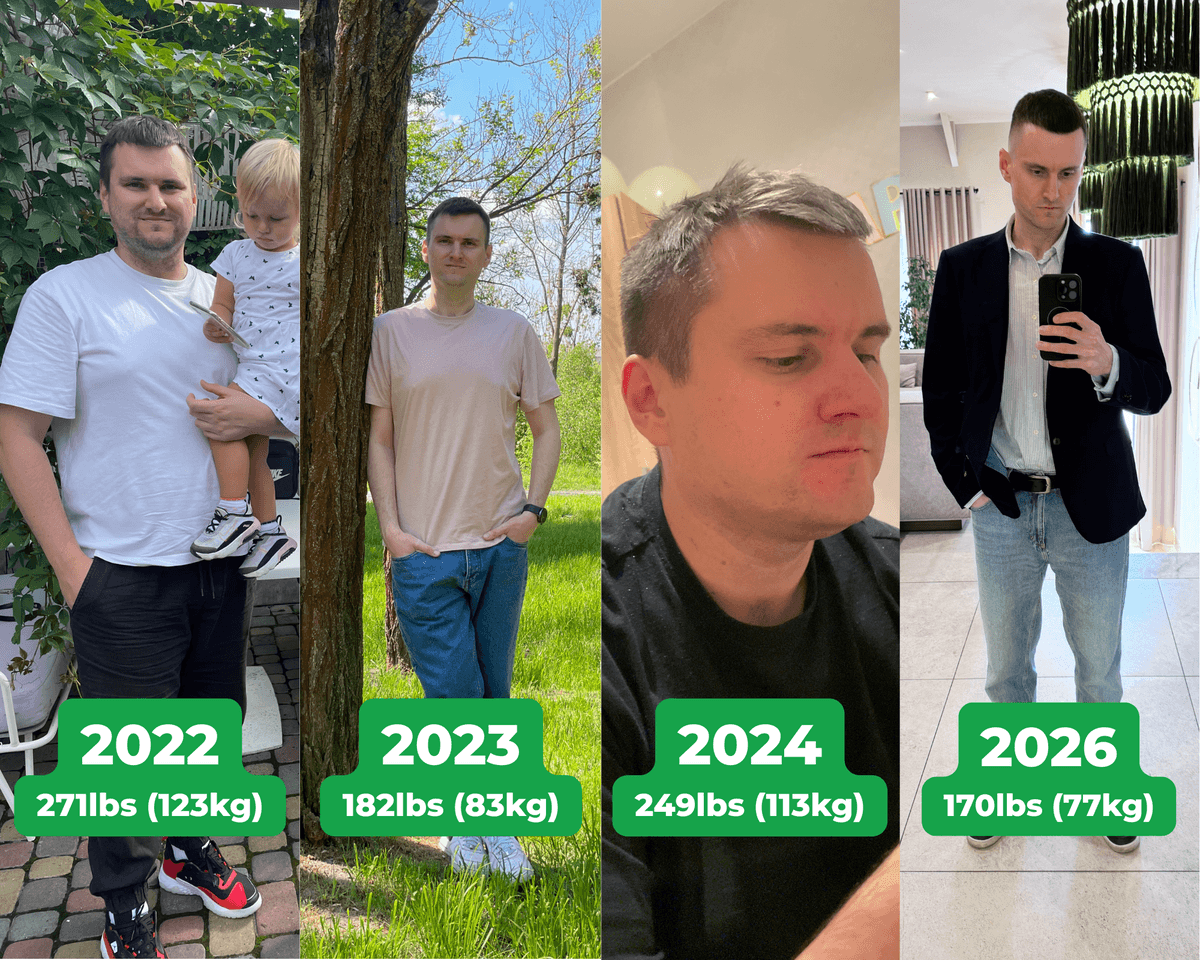

You hit your goal weight. Now what?
This is the part nobody talks about. Every diet article, every meal plan, every calculator is focused on losing weight. But the moment you reach your goal, you're on your own — and that's when most people regain everything they lost.
It doesn't have to be that way. Maintenance is a skill, and it's simpler than you think.
Step 1: Find Your Maintenance Calories
Your maintenance calories are the number where you don't gain or lose — your body stays at the same weight. Use our daily calorie calculator with your current (goal) weight and select your actual activity level.
If you've been eating 1,500 cal to lose weight and your calculator says maintenance is 2,000, that's 500 more calories per day. But don't jump straight to 2,000 — your body needs to adjust gradually.
Step 2: Reverse Diet (Don't Jump)
Reverse dieting means increasing calories slowly — about 100-150 calories per week — instead of jumping from your deficit to maintenance overnight.
Why it matters:
- Your metabolism adapted to the deficit. During weight loss, your body reduced NEAT (unconscious movement), lowered thyroid output slightly, and became more efficient. Jumping to maintenance immediately can cause a temporary overshoot because these adaptations haven't reversed yet.
- Your appetite hormones are elevated. After dieting, ghrelin (hunger hormone) is higher and leptin (satiety hormone) is lower. Adding calories gradually gives these time to normalize.
- Your habits need recalibration. You've been eating a certain amount for weeks or months. Going from 1,500 to 2,000 in one day feels like a lot of food. Gradual increase feels natural.
The timeline:
- Week 1: Add 100 cal/day (1,500 → 1,600)
- Week 2: Add another 100 (1,600 → 1,700)
- Week 3: Add another 100 (1,700 → 1,800)
- Week 4-5: Continue until you reach your calculated maintenance
Weigh yourself throughout. Your weight will go up 2-4 lbs in the first 1-2 weeks — this is glycogen and water refilling, not fat. It stabilizes after 2-3 weeks.
Step 3: Keep Weighing (But Change How You Think About It)
During weight loss, the scale was your progress tracker. During maintenance, it's your early warning system.
Set a range — your goal weight ± 3 lbs. For example, if your goal is 160 lbs, your range is 157-163. Normal daily fluctuations (see our weight fluctuations guide) keep you bouncing within this range.
If your weekly average goes above your range for 2+ consecutive weeks: You're eating slightly above maintenance. Drop 200 calories for 2 weeks. Don't panic — a small correction early prevents a bigger problem later.
If your weekly average drops below your range: You're still in a deficit. Add 100-200 calories. You don't need to keep losing.
Weigh daily, calculate weekly averages, act on 2-week trends. The same system you used during weight loss — just with a different target.
Step 4: Keep the Habits That Got You Here
The habits that made you lose weight are the same ones that keep it off:
- Meal structure. You don't need to eat the same meals forever, but keep the protein-first, measured-portions approach. Our macro calculator gives you maintenance targets.
- Cooking at home. Restaurant meals are still 1,000-1,500 cal. The difference is now you can afford one without it derailing your week — as long as you plan for it.
- Weekly awareness. You don't have to log every calorie forever. But check in once a week — a quick food diary day or a mental audit of portion sizes. Most regain happens when people stop paying attention entirely.
- Exercise for maintenance, not weight loss. During the deficit, exercise was optional. During maintenance, it's your buffer. 3 strength training sessions and daily walking give you 200-300 extra calories of daily budget — that's the difference between "maintenance feels restrictive" and "maintenance feels easy."
Step 5: Plan for Real Life
Holidays, vacations, stressful weeks, injuries — life will push you above maintenance sometimes. That's fine. The people who keep weight off aren't the ones who never overeat — they're the ones who correct quickly.
The 5-lb rule: If your weekly average goes 5 lbs above your goal weight, go back to a mild deficit (300 cal below maintenance) until you're back in range. Don't wait until it's 15 lbs. A 5-lb correction takes 5 weeks. A 15-lb correction takes 4 months.
This is why the scale stays in your routine forever. Not as punishment — as information.
Why People Regain (And How to Not Be One of Them)
Research shows that 80% of people who lose weight regain it within 2 years. The common reasons:
- "I reached my goal, so I'm done." Weight management isn't a project with an end date. The skills are forever — the intensity relaxes, but the awareness stays.
- All-or-nothing thinking. One bad meal → "I blew it" → a bad week → "I'll start over Monday" → a bad month. One meal is never the problem. The spiral after it is.
- Returning to old portions. Your "normal" portions before dieting were the ones that made you gain weight. Your new normal is what you've been eating during the deficit — just slightly more of it.
- Stopping the scale. Out of sight, out of mind. By the time clothes feel tight, you're already 10+ lbs above goal.
Your Maintenance Checklist
- ☐ Calculate maintenance calories with our calorie calculator
- ☐ Reverse diet: add 100 cal/week until you reach maintenance
- ☐ Set your weight range: goal weight ± 3 lbs
- ☐ Weigh daily, track weekly averages
- ☐ If 2+ weeks above range: cut 200 cal temporarily
- ☐ Keep meal structure (protein first, measured carbs, budgeted fat)
- ☐ Exercise 3x/week (strength) + daily walking
- ☐ One food diary day per week (spot-check portions)
- ☐ Use the 5-lb rule for quick corrections
Maintenance isn't as exciting as losing weight. Nobody celebrates staying the same. But keeping weight off for 2 years is harder and more impressive than losing it in 2 months. The tools are the same — calculators, recipes, guides — just applied with less intensity and more patience.

