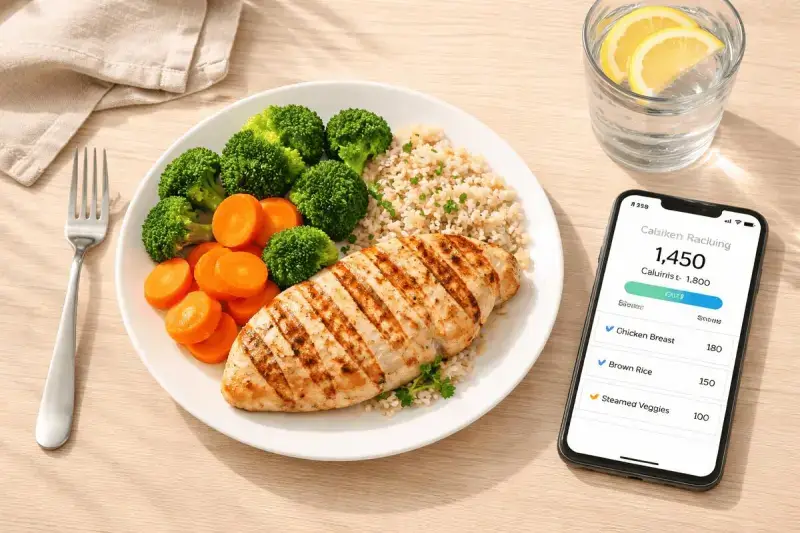

To lose weight without counting calories every day, count them once: when you build your eating structure. An eating structure is how many times a day you eat and how many grams of protein, carbs, vegetables and fat go on each plate. You repeat it every day and swap the foods inside it. Weight comes off when you eat less energy than you burn, and because the portions never change, you hit that number every day without tracking it again.
What an eating structure is
Every plate has four parts: a portion of meat, fish or eggs, a portion of rice, pasta, potatoes or another starch, vegetables, and a little fat. You decide the grams for each part once, and then the grams stay put.
Only the food changes. Chicken and rice today, cod and quinoa tomorrow, pork and potatoes the day after. The calories barely move from one day to the next, so there is nothing to recount. You also stop deciding what to cook from scratch: the only choice left is which meat and which starch.
In March 2026 the journal Health Psychology published a 12-week study of 112 people trying to lose weight. Everyone logged their meals in an app and weighed in every day. The people who repeated the same meals more often lost 5.9% of their body weight on average, against 4.3% for those who ate a more varied diet. People whose calories stayed steady from day to day lost more too. The researchers only watched what people ate, so the study can't prove that repetition caused the difference. My guess is that a routine makes the energy deficit easier to keep.
Don't forget fat
Lean meat and rice leave almost no fat on the plate. 250 g (8.8 oz) of raw chicken breast and 100 g (3.5 oz) of dry rice together carry about 7 g of fat. Get at least 0.3 g of fat per pound of body weight a day: 45 g at 150 lb, 51 g at my 170 lb. That keeps you above the World Health Organization's floor of 15% of calories from fat. So put a fat source on every plate: 2 teaspoons of olive oil on the salad (9 g of fat), one large egg (5 g), 1 oz of cheddar (9 g) or 20 g of walnuts (13 g). Count those calories into your target when you build the structure.
Step 1. Find your calorie target
This is the one calculation you can't skip. Get your daily target for weight loss from the daily calorie calculator. It uses your weight, height, age and activity level. Someone who burns 2,300 calories a day, for example, would land at about 1,800 to lose weight. The calculator subtracts that gap for you, and what a calorie deficit is explains how big it should be.
Step 2. Build your eating structure
Decide how many times a day you want to eat: twice, three times, or three meals and a snack. Split your target between those meals. To see how many grams of meat and rice make a given number of calories, use the meal calculator.
Here is mine. I went from 271 lb to 170, I'm 6'2" and I train in the gym, so my target is higher than most. Lunch and dinner are the same plate, with a banana before the gym and a snack after it.
| When | What I eat | Calories |
|---|---|---|
| Lunch, 11:30 | 250 g (8.8 oz) raw meat, 100 g (3.5 oz) dry rice or pasta, about 200 g (7 oz) of vegetables, 5 g (1 tsp) butter, a slice of cheese or a boiled egg | about 820 |
| 2:00 PM, before training | A medium banana | 105 |
| 4:30 PM, after training | 100 g (about 1¼ cups) quick oats and 2 tablespoons of low-fat sweetened yogurt | about 400 |
| Dinner, 7:00 PM | Same as lunch | about 820 |
Calories: USDA FoodData Central. Lunch and dinner are counted with chicken breast and white rice.
The meat, the starch and the vegetables change every day. The grams don't. I built this structure after I put 66 lb back on, and I wrote about that in how small food habits change your weight.
My grams are built on my target, so yours will look different. If you don't want to build the structure yourself, the free meal plan generator puts together a week at your calorie target, with a shopping list. If you'd like me to build it for you, from the food you cook and around the hours you eat, I write personal meal plans by hand, for under $1 a day.
Step 3. Swap the meat and the starch
The starch is the easy swap. Dry rice, pasta, quinoa and oats are almost identical in calories, so 100 g of rice becomes 100 g of quinoa with nothing to recount. Meat and fish swing more: up to 175 calories a portion.
| Food | Portion | Calories | Protein, g |
|---|---|---|---|
| Chicken breast | 250 g (8.8 oz) raw | 300 | 56 |
| Turkey breast | 250 g (8.8 oz) raw | 285 | 59 |
| Pork tenderloin | 250 g (8.8 oz) raw | 273 | 53 |
| Chicken thigh, boneless, skinless | 250 g (8.8 oz) raw | 365 | 47 |
| Ground beef, 93% lean | 250 g (8.8 oz) raw | 380 | 52 |
| Cod | 250 g (8.8 oz) raw | 205 | 45 |
| White rice | 100 g (3.5 oz) dry | 365 | 7 |
| Brown rice | 100 g (3.5 oz) dry | 367 | 8 |
| Quinoa | 100 g (3.5 oz) dry | 368 | 14 |
| Pasta | 100 g (3.5 oz) dry | 371 | 13 |
| Oats | 100 g (3.5 oz) dry | 379 | 13 |
| Potato | 450 g (1 lb) raw | 347 | 9 |
| Sweet potato | 440 g (15.5 oz) raw | 348 | 7 |
Calories and protein: USDA FoodData Central, raw or dry weight.
The grains and pasta sit within 14 calories of each other, the potatoes within 20. Chicken thigh instead of breast adds 65 calories, 93% lean beef adds 80, and cod takes 95 off. If thighs or ground beef are your daily meat, drop the portion to 200 g (7 oz). On cod days you can add 25 g of dry rice and stay at the same total.
Weigh everything raw or dry. Cooked rice weighs almost three times as much as dry, and meat loses water in the pan, so cooked weights throw the numbers off (the raw-or-cooked rule for every food). Measure oil with a spoon too: one tablespoon of olive oil is 119 calories, and the calories in a tablespoon table has 37 more.
Step 4. Watch the scale
Once the structure is built, the only thing to check is whether your weight is going down. Weigh yourself every morning before breakfast and compare this week's average with last week's. Salt and water can add 2 lb overnight. That's a normal weight fluctuation, and the weekly average cancels it out.
If the weekly average drops by 0.5-1% of your body weight, change nothing. If it drops slower for three weeks, take 25 g of starch off one meal. If it drops faster than 1%, add 25 g. The weight loss calculator shows how many weeks it takes to reach your goal at your pace.
When to recount
Rebuild the structure if:
- your weekly average hasn't moved for three weeks in a row;
- you move a lot more or a lot less, say you started lifting or switched to a desk job;
- you've lost 10 lb or more, because a smaller body burns fewer calories.
Run the calculator again and change the grams of one food, usually the starch. Leave the rest of the structure alone.
How to come off a deficit or gain weight
The same structure works when you've reached your goal weight and when you want to build muscle. The meat, the vegetables and the fat stay as they are. You only change the grams of the starch. 25 g (about 2 tablespoons) of dry rice or grain is about 90 calories.
To come off a deficit slowly, which is what reverse dieting means, add 25 g of dry starch to one meal each week and watch your weekly average. When it holds steady for two or three weeks, you've found your maintenance calories. To build muscle alongside strength training, keep adding starch until you're eating 200-300 calories above maintenance. The daily calorie calculator gives you a maintenance and a gain target as well.
If you don't have time to cook every day
I cook for several days at once. Cook the grain and bake the meat for two or three days, portion it into containers by your structure, and add the vegetables when you eat, the way I do in these high-protein meal prep containers. Every portion is already weighed, so at 7 PM when you're tired there's nothing to decide. If you'd rather not pick even the meat and the starch, take a ready-made week with a shopping list: 1,200 calories, 1,500 calories, 1,800 calories or the $40 budget week.