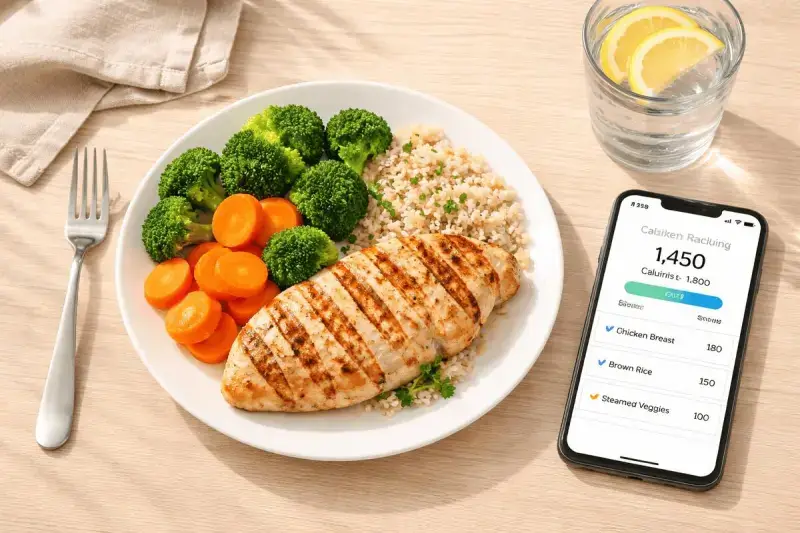



Step 1: Find Your Number
Before you change a single thing about what you eat, you need one number: your Total Daily Energy Expenditure (TDEE). That's how many calories your body burns in a day — just existing, moving around, and doing whatever you do.
Use our daily calorie calculator to find yours. It takes 30 seconds. Once you have it, subtract enough to lose about 0.5-1% of your body weight per week. For a 180 lb (82 kg) person, that lands around 500 calories a day - roughly 0.5 kg (1 lb) per week. If you're smaller, cut less - closer to 250-350. The right deficit scales with your size.
For example: if you weigh around 180 lbs and your TDEE is 2,300 calories, your target is 1,800. That's it. No special diet required — just eat fewer calories than you burn.
Want to see exactly when you'll reach your goal? Our weight loss calculator shows you a week-by-week timeline with milestones. It even adjusts for the fact that weight loss slows down as you get lighter.
If you're not sure what a calorie deficit actually is, this explainer breaks it down.
Once you have your target, our free meal plan generator will turn it into a 7-day plan of simple, repeatable meals with a short grocery list, no signup needed. Or grab one of our fixed meal plans — 1,500 calories or 1,800 calories — for a full week of meals with a shopping list.
Step 2: Get a Food Scale (and an Oil Sprayer)
These are the two best purchases you'll make for weight loss. Not a gym membership. Not a supplement. A kitchen scale and an oil sprayer.
Here's why the scale matters: people are terrible at estimating portion sizes. In a 1992 study in the New England Journal of Medicine, people who were certain they could not lose weight on 1,200 calories a day were actually eating 47% more than they reported. A "tablespoon" of peanut butter eyeballed from the jar? That's usually 2-3 tablespoons. A "medium" chicken breast? Could be anywhere from 120g to 250g.
A food scale removes the guesswork. Put your plate on the scale, zero it out, add your food, and log the actual weight. Suddenly your calorie counts are accurate.
And the oil sprayer? One tablespoon of olive oil is 120 calories. Most people pour 2-3 tablespoons into a pan without thinking — that's 240-360 calories of invisible fat. An oil sprayer turns that into a fine mist — about 5 calories per spray. Same non-stick effect, 95% fewer calories. On a pan you would have poured two tablespoons into, that swap is about 230 calories.
What to buy
Kitchen scale (~$10-15): Any basic digital scale that measures in grams and ounces. The Etekcity Food Kitchen Scale is a solid choice — stainless steel platform, tare function, runs on 2 AAA batteries. It does one thing well: weigh food accurately.
Oil sprayer (~$10-15): A refillable glass oil sprayer you fill with your own olive oil. The NORBASE Oil Sprayer (2-pack) works well for air fryer and stovetop cooking. Fill it once, use it all week. Saves hundreds of calories without changing what you cook.
Together, that's about $25 — less than a single takeout meal — and it'll change how you eat permanently.
Step 3: Track Everything for One Week (Without Changing Anything)
Don't start "dieting" yet. For the first week, just eat normally and track everything. Every meal, every snack, every splash of oil in the pan.
This does two things:
- Awareness — You'll discover where your calories actually come from. Most people find 2-3 "calorie bombs" they didn't realize they were eating (cooking oil, sauces, drinks, that second serving of rice).
- Baseline — You'll see how much you actually eat vs. how much you think you eat. The gap is almost always bigger than expected.
Use any free calorie tracking app — MyFitnessPal, Cronometer, or even a simple notes app. The tool doesn't matter. The habit does.
For a full guide on tracking without it taking over your life, read How to Count Calories Without Losing Your Mind.
Step 4: Start Your Deficit
After your tracking week, you know your baseline. Now cut your Step 1 deficit out of it - around 500 calories if you weigh about 180 lbs, closer to 300 if you're smaller. Not 1,000 — that's too aggressive for most people and leads to burnout.
At a 500-calorie deficit, the math looks like this:
- ~0.5 kg (1 lb) lost per week
- ~2 kg (4.5 lbs) lost per month
- ~6 kg (13 lbs) lost in 3 months
That might sound slow. It's not. It's the speed that actually works long-term. Crash diets take it off faster, and the weight usually comes back - the size of your deficit is what changes that.
Where should those calories come from? Start with the calorie bombs you found in Step 3. Some common quick wins from our guide to cutting 500 calories:
- Switch from pouring oil to using an oil sprayer (saves 100-200 cal per meal)
- Cook with an air fryer instead of deep frying or pan frying
- Measure your rice, pasta, and cereal instead of eyeballing
- Replace caloric drinks with water or zero-calorie alternatives
Once you have your calorie target, use our macro calculator to figure out the right protein, carb, and fat split. Getting enough protein (at least 1.6g per kg of body weight) helps preserve muscle while you lose fat.
Step 5: Cook Simple Meals
The easiest meals to track are the ones you cook yourself, with few ingredients. You don't need fancy recipes — a protein, a carb, and a vegetable is a complete meal.
Here's what a ~1,800 calorie day could look like using recipes from our site:
- Lunch: Smoky Paprika Air Fryer Chicken Breast (277 cal) + Seasoned Potato Wedges (344 cal) = 621 cal
- Dinner: Soy-Garlic Air Fryer Chicken Thighs (279 cal) + rice (200 cal) + vegetables (80 cal) = 559 cal
- Snacks: Protein Brownies (2 × 101 cal = 202 cal) + fruit (100 cal) + yogurt (150 cal) = 452 cal
- Total: ~1,632 cal — leaves room for cooking oil, sauces, and coffee with milk.
Every recipe on this site has an exact calorie count because every ingredient was weighed. That's what makes tracking easy. Browse our full recipe collection — everything is real food, real photos, real calorie counts.
If you have an air fryer, you're in luck — here are 7 recipes under 400 calories that taste like they shouldn't be low-calorie. Don't have one? Our guide to budget air fryers covers the best options under $50.
Step 6: Meal Prep One Day a Week
The number one reason people break their calorie deficit is convenience. You're tired after work, you don't feel like cooking, so you order takeout — 1,200 calories of mystery portions.
The fix: spend 1-2 hours on Sunday cooking 3-4 meals for the week. When hunger hits on a Wednesday night, your food is already in the fridge — measured, tracked, ready to reheat.
We wrote a whole guide on this: Meal Prep Is the Best Way to Manage Your Weight. The short version:
- Pick 2-3 recipes you like
- Cook in bulk
- Divide into containers (weigh each portion!)
- Refrigerate what you'll eat in 3 days, freeze the rest
Containers matter
Good meal prep containers make the habit stick. Look for BPA-free, microwave-safe, leak-proof containers with separate compartments. The Bentgo Prep containers (20-pack, ~$20) are PFAS-free and hold up well after dozens of microwave cycles. Glass containers like EcoPreps with bamboo lids are a plastic-free option if you prefer that.
Step 7: Move More (But Don't Obsess Over It)
Exercise is great for your health, mood, and muscle preservation. But for weight loss specifically, your diet does 80% of the work.
You cannot out-exercise a bad diet. Running for 30 minutes burns about 300 calories — one muffin. It's much easier to not eat the muffin.
That said, here's what actually helps:
- Walking — 30 minutes of brisk walking daily burns 150-200 extra calories. It's the most underrated exercise for weight loss. No gym required.
- Strength training — 2-3 sessions per week preserves muscle mass while you lose fat. Muscle burns more calories at rest, so keeping it helps your metabolism.
- Daily movement — Take stairs, walk to the store, stand while working. These "non-exercise" calories (called NEAT) can add up to 200-500 calories per day.
Curious how much faster you'd reach your goal with more activity? Use our weight loss calculator — it has a "What if I was more active?" comparison mode that shows the difference.
The First Two Weeks Are the Hardest
Your body is used to eating a certain amount. When you cut several hundred calories, it notices. You'll feel hungrier for the first 1-2 weeks. This is normal and it passes.
Tips that help:
- Eat more protein — it keeps you full longer than carbs or fat
- Eat more vegetables — high volume, low calories (look up "volume eating")
- Drink water — thirst often feels like hunger. Use our water intake calculator to find your daily target.
- Don't skip meals — spreading your calories across the day prevents the "I'm starving so I'll eat everything" moments (unless you do intermittent fasting intentionally)
And if you mess up one day? It genuinely doesn't matter. One bad day in a week of good days still results in weight loss. The goal is consistency over perfection.
Your Checklist
Here's everything in one place:
- ☐ Calculate your TDEE and size your deficit (0.5-1% of your body weight per week)
- ☐ Buy a food scale and an oil sprayer
- ☐ Track your normal eating for one week
- ☐ Start your deficit
- ☐ Find your macro targets (prioritize protein)
- ☐ Cook simple meals with real calorie counts
- ☐ Meal prep once a week
- ☐ Walk 30 minutes daily
- ☐ Check your projected timeline and celebrate milestones
You don't need to do all of this on day one. Start with steps 1-3 this week. Add 4-5 next week. Build the system gradually — the weight will follow.